30mg High Quality Saffron Extract per Capsule

Introduction
Dura life saffron _manufactured by Faran Shimi Pharmaceutical Company_ is supplied in 30 mg High quality saffron extract. 30 capsules are packed in one bottle and the bottle is packaged in one box with a leaflet.
Indications
It is used for antidepressant effects, energy booster, mood and memory improvement, maintain eye health, and aphrodisiac properties.
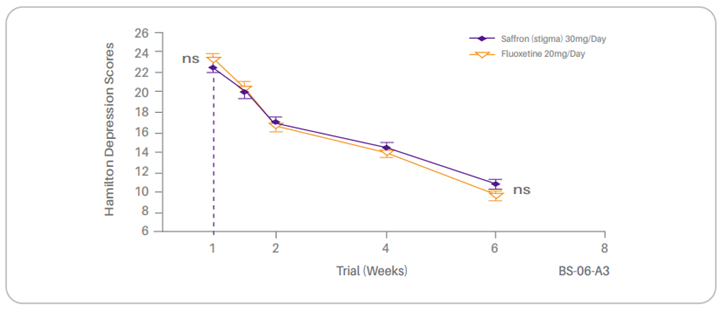
Studies Shown, saffron supplements were significantly more effective than placebos at treating symptoms of mild-to-moderate depression6. Taking 30 mg of saffron daily was just as effective as Fluoxetine, Imipramine, and Citalopram — conventional treatments for depression. Additionally, fewer people experienced side effects from saffron compared to other treatments7, 8, and 9.
The Fluoxetine-Like Effect of Saffron10:
In vitro and in vivo preclinical studies demonstrated efficacy of saffron in attenuating cognitive impairment in animal models of AD. In particular, crocin appears to be multifunctional in brain cell-protection because it is capable of regulating glutamate levels, reducing oxidative stress, modulating Aβ and tau protein aggregation and improving cognitive impairment12.
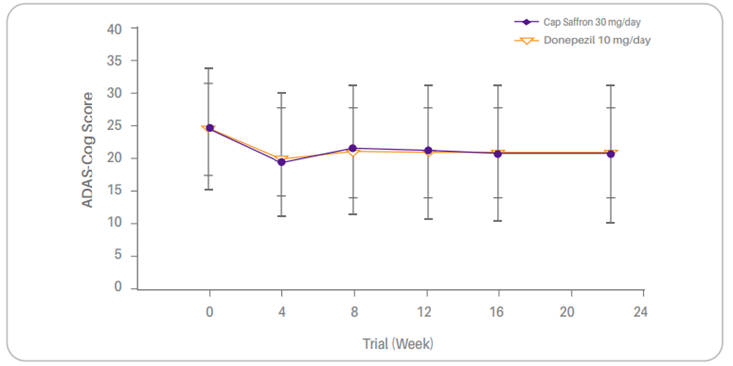
The results of studies suggest that saffron may be beneficial to improve cognitive function in patients with AD.
The Donepezil-Like Effect of Saffron13:
Important Information
Dosing
Prescribe 30-60mg (One or two Capsules) daily
Dosage Adjustment
- no dosage adjustment necessary
Administration
- Administer one or two tablets daily, with the main meal and a full glass of water.
Interactions
Major Interactions (Risk D)[1]
- There is no major interaction between Dura life saffron and other drugs.
Pregnancy
- The studies are not adequate about saffron in pregnancy.
- Saffron crosses the placenta and it has not been recommended in pregnancy.
Breast-Feeding
- Saffron is present in breast milk. More studies are needed about administration in breast-feeding. It has not been recommended in breast-feeding.
Contraindications & Cautions
Contraindications
- Hypersensitivity to Dura life saffron or any component of the formulation.
- Pregnancy and breastfeeding
Warnings/Precautions
- Bipolar disorder: use with caution in patient with bipolar disorder
- Diabetes: Saffron might affect blood sugar levels and cause hypoglycemia, use with caution in diabetic patient.
- Stop taking saffron at least two weeks before scheduled surgery. Avoid prescribing more than the recommended amount.
Side Effects
Saffron is likely safe in recommended dose, nausea, vomiting, Headache and allergic reactions can occur in some people.
References
- 1. World Health Organization Depression and Other Common Mental Disorders. Geneva: Global Health Estimates; (2017).
- 2. Minor depression: risk profiles, functional disability, health care use and risk of developing major depression. Cuijpers P, de Graaf R, van Dorsselaer S J Affect Disord. 2004 Apr; 79(1-3):71-9.
- 3. Saffron (Crocus sativus) for depression: a systematic review of clinical studies and examination of underlying antidepressant mechanisms of action. Lopresti AL, Drummond PD Hum Psychopharmacol. 2014 Nov; 29(6):517-27.
- 4. Rios JL, Recio MC, Giner RM, Manez S. An update review of saffron and its active constituents. Phytother Res. (1996) 10:189–93. 10.1002/ (SICI) 1099-1573(199605)10:3<189: AID-PTR754>3.0.CO; 2-C.
- 5. Akhondzadeh S, Tahmacebi-Pour N, Noorbala AA, Amini H, Fallah-Pour H, Jamshidi AH, Khani MPhytother; Crocus sativus L. in the treatment of mild to moderate depression: a double-blind, randomized and placebo-controlled trial Res. 2005 Feb; 19(2):148-51.
- 6. Ann Hausenblas, Debbie Saha, J Integr; Saffron (Crocus sativus L.) and major depressive disorder: a meta-analysis of randomized clinical trials. 2013 Nov; 11(6): 377–383. doi: 10.3736/jintegrmed2013056
- 7. A Noorbala , S Akhondzadeh, N Tahmacebi-Pour, A H Jamshidi, Hydro-alcoholic extract of Crocus sativus L. versus fluoxetine in the treatment of mild to moderate depression: a double-blind, randomized pilot trial;PMID: 15707766 DOI: 10.1016/j.jep.2004.11.004.
- 8. L Kashani, S Eslatmanesh, N Saedi, N Niroomand, M Ebrahimi, M Hosseinian, T Foroughifar, S Salimi, S Akhondzadeh; Comparison of Saffron versus Fluoxetine in Treatment of Mild to Moderate Postpartum Depression: A Double-Blind, Randomized Clinical Trial; PMID: 27595298 DOI: 10.1055/s-0042-115306.
- 9. Mojtaba Shafiee, Soheil Arekhi, Alireza Omranzadeh, Amirhossein Sahebkar; Taking 30 mg of saffron daily was just as effective as Fluoxetine, Imipramine, and Citalopram — conventional treatments for depression. Additionally, fewer people experienced side effects from saffron compared to other treatments; Epub 2017 Nov 7; PMID: 29136602 DOI: 10.1016/j.jad.2017.11.020.
- 10. Mojtaba Khaksarian, Masoud Behzadifar; The efficacy of Crocus sativus (Saffron) versus placebo and Fluoxetine in treating depression: a systematic review and meta-analysis; Published online 2019 Apr 23. Doi: 10.2147/PRBM.S199343.
- 11. World Health Organization. Dementia. 2017. http://www.who.int/mediacentre/factsheets/fs362/en/
- 12. Grazia D’Onofrio, Seyed Mohammad Nabavi, Crocus Sativus L. (Saffron) in Alzheimer’s Disease Treatment: Bioactive Effects on Cognitive Impairment; Current Neuropharmacology, 2021, 19, 1-0, DOI: 10.2174/1570159X19666210113144703.
- 13. Shahin Akhondzadeh, Mehdi Shafiee Sabet, Mohammad Hossein Harirchian; A 22-week, multicenter, randomized, double-blind controlled trial of Crocus sativus in the treatment of mild-to-moderate Alzheimer’s disease, Psychopharmacology (Berl). 2010 Jan;207(4):637-43, DOI: 10.1007/s00213-009-1706-1